

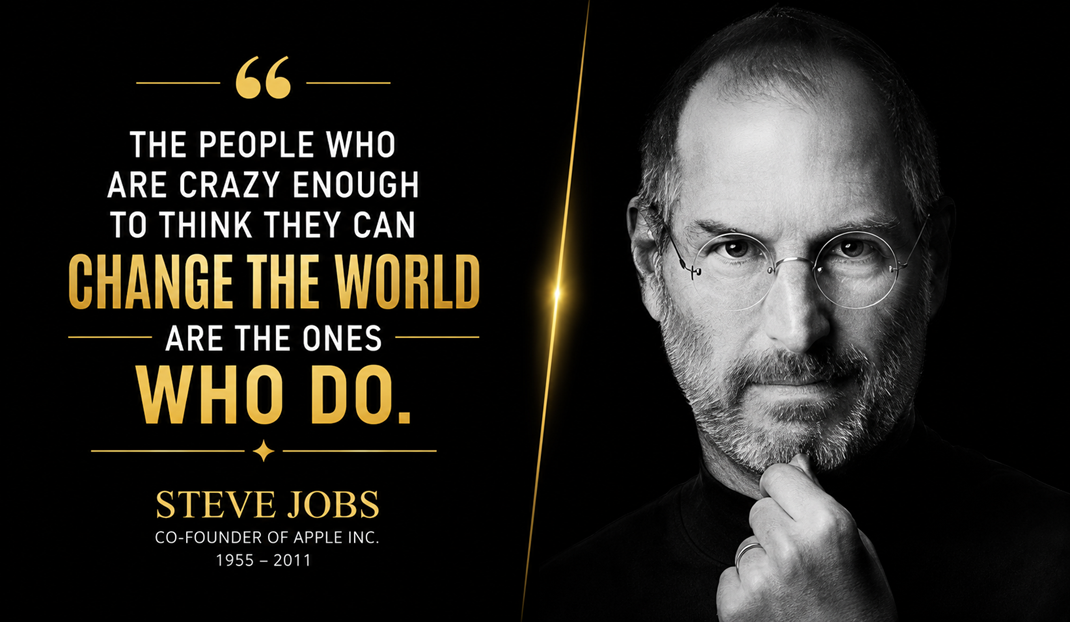
"The people who are crazy enough to think they can change the world are the ones who do." — Steve Jobs
Some people build businesses. Others create products. But every once in a while, someone comes along who changes the way the world thinks. Steve Jobs was one of those rare individuals. He wasn't born into privilege, nor did he follow the traditional path to success. He experienced failures, rejection, and setbacks, yet he never stopped believing that great ideas could change lives.
More than a decade after his passing, his influence continues to shape how we communicate, work, learn, and create. While millions admire the iPhone, the Mac, or Pixar, I believe Steve Jobs' greatest gift wasn't the products he built—it was the mindset he left behind.
Here are seven lessons from his journey that continue to inspire me and millions of others around the world.
1. Don't Build for Money. Build for Meaning.
When I read about Steve Jobs, one thing always stands out to me. He wasn't obsessed with becoming the richest man in the world. He was obsessed with building something that people would genuinely love. That's a very different mindset. Money follows value. If your only goal is profit, you'll probably make short-term decisions. But if your goal is to solve a real problem or make someone's life better, people will remember you long after the money is spent.
Whether you're running a company, starting a business, or leading a team, ask yourself: Am I creating something that truly matters? Every successful organisation begins with a purpose that is bigger than profits. The businesses that stand the test of time are those that improve people's lives, not just their balance sheets.
2. Simplicity Is Harder Than Complexity.
Most people think adding more features makes a product better. Steve Jobs believed the opposite. He spent countless hours removing unnecessary things until only what truly mattered remained. That's much harder than adding more. It requires discipline, confidence, and clarity.
The same lesson applies to our everyday lives. We often complicate our businesses, our presentations, and even our communication. But the best leaders are usually the clearest communicators. They make difficult ideas easy to understand. Simplicity isn't about doing less because you're lazy—it's about doing less because you know exactly what matters. Whether you're presenting to a board or speaking to your team, people remember clarity far more than complexity.
3. Learn to Say "No" Without Feeling Guilty.
One of the hardest leadership skills isn't making decisions—it's saying no. Steve Jobs famously eliminated hundreds of projects so Apple could focus on a handful of truly exceptional ones. He understood that focus isn't about doing more; it's about protecting what matters most.
Many of us struggle with this. We say yes because we don't want to disappoint people, lose opportunities, or appear unhelpful. But every yes comes at a cost. It costs time, energy, and attention that could have been invested elsewhere. Sometimes, saying no isn't closing a door—it's keeping the right one open. Great leaders understand that focus is one of their greatest competitive advantages.
4. Never Stop Being Curious.
One of my favourite stories about Steve Jobs is that he attended a calligraphy class after dropping out of college—not because it would help his career, but simply because he found it fascinating. Years later, those lessons influenced the beautiful typography that became part of the Macintosh computer and eventually transformed personal computing.
That story reminds us that not everything we learn has an immediate purpose. Sometimes the knowledge we gain today becomes tomorrow's greatest advantage. Stay curious. Read books outside your field. Listen to people with different perspectives. Travel when you can. Ask questions. Curiosity has a remarkable way of connecting the dots in ways we never expect.
5. Excellence Is a Habit, Not a One-Time Achievement.
Steve Jobs had exceptionally high standards. While some people criticised his demanding nature, no one could deny his commitment to quality. He believed that every detail mattered, even the ones customers would never see. That relentless pursuit of excellence became part of Apple's identity.
The lesson isn't about chasing perfection. It's about refusing to settle for mediocrity. Every presentation, proposal, conversation, and decision reflects your personal brand. People notice consistency. Excellence isn't achieved in one extraordinary moment; it's built through small, intentional choices made every single day. Over time, those choices become your reputation.
6. Don't Be Afraid to Challenge the Norm.
When Apple introduced the iPhone, many experts doubted it would succeed. When familiar features disappeared from Apple's products, critics questioned the decisions. Yet Steve Jobs understood something important: innovation often looks strange before it becomes obvious.
Every generation has people who are willing to challenge what everyone else accepts. They ask different questions. They imagine better possibilities. They aren't reckless; they're courageous. Leadership isn't about following the safest path. Sometimes it's about believing in a vision long before the rest of the world sees it. Progress has always belonged to those who dared to think differently.
7. Build a Legacy That Outlives You.
Steve Jobs passed away in 2011, but his influence continues to shape our daily lives. That's what true legacy looks like. It isn't measured by wealth, titles, or awards. It's measured by the lives you impact and the ideas that continue to inspire long after you're gone.
Every one of us has an opportunity to leave something meaningful behind. It might be a business, a movement, a community, a breakthrough idea, or simply the people we've encouraged along the way. At the end of our careers, very few people will remember how many meetings we attended or how many emails we answered. They will remember how we made them think, how we made them feel, and what we contributed to the world.
As leaders, entrepreneurs, and changemakers, perhaps the most important question we can ask ourselves is not, "How successful can I become?" but rather, "What difference will my life make?"
Because success may open doors.
But legacy leaves them open for others.
Editor's Reflection
Every edition of Impact Legacy will celebrate individuals whose ideas have transformed industries, communities, and generations. Not because they were perfect, but because they had the courage to dream beyond what seemed possible.
Steve Jobs reminds us that innovation begins with curiosity, leadership begins with purpose, and true success is measured not by what we accumulate, but by the impact we leave behind.
What legacy are you building today?